
Intoxicating hemp products have rapidly proliferated across Georgia’s retail marketplace, driven by manufacturers profiting from loopholes in the federal 2018 Farm Bill and gaps in Georgia’s regulatory framework. Georgia’s lawmakers have been interested in studying this issue further, and they have established a legislative committee to analyze and inform further recommendations for policies and systems changes during the upcoming legislative session.
A Georgia-based non-profit health coalition, Let’s Be Clear Georgia, and Counter Tools partnered together to lead a project focused on studying the landscape of intoxicating consumable hemp products and other intoxicating products in Georgia’s retail stores. During September and October 2025, community health staff and partners conducted retail store assessments at retailers within six different Georgia counties. This provided beneficial geographic diversity covering urban, suburban, and more rural areas across northern, central, and southern Georgia. There was also diverse representation in terms of the type of stores assessed, which included convenience stores, tobacco and vape shops, liquor/package stores, grocery stores, and drug stores. At these retail establishments, store assessors examined the types and forms of products sold, product promotion and advertisements, product accessibility within the store, products attractive to children, product constituents, product potency, and required store signage.
“A legislative study committee was formed to learn more about hemp consumables in Georgia. Recognizing that Georgia had no data on these products, our organization contacted Counter Tools to discuss conducting a retail assessment to be used to inform the public and policymakers about what is available in our state. The data confirmed what we had heard and seen. Stores were not abiding by the law, putting Georgia’s youth at risk,” said Charlotte Spell, Executive Director of Let’s Be Clear Georgia.
These retail store assessments revealed extensive non-compliance with Georgia law and widespread availability of highly potent intoxicating hemp products and other intoxicating products posing significant public health risks.
Findings showed:
1. Widespread non-compliance
More than half of all assessed stores sold prohibited hemp product types, including smokable flower and hemp-infused foods. Nearly one-third failed to post the required 21+ age-of-sale signage.
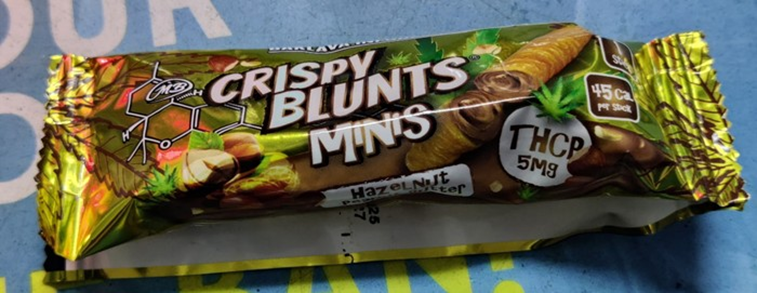
A hazelnut “crispy blunts” (wafer candy) containing consumable hemp found in a Georgia retailer. This is in violation of state law, which prohibits hemp-adulterated or hemp-infused food products.
2. Youth exposure and appeal
Nearly 70% of stores sold hemp-derived cannabis products that are attractive to children, including items using candy imagery, copycat branding, cartoon characters, and kid-focused flavors.
3. Potency loopholes
While Georgia state law limits Delta-9 THC potency for gummies and beverages, manufacturers circumvent these rules by using other intoxicating cannabinoids such as Delta-8, Delta-10, HHC, and THC-P. As a result, 55% of stores selling gummies offered products exceeding 300 mg THC/HHC per package, and 61% sold single gummies exceeding 10 mg per piece.
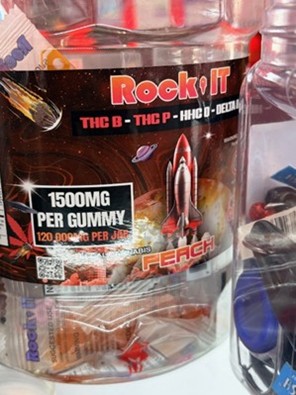
1,500mg per gummy; 120,000 mg per jar. Containing a mixture of semi-synthetic and chemically synthesized cannabinoids and advertised with cartoon rocket ships. With a psychotropic effect typically starting at around 5 mg of THC consumption, this is 300 times that amount per gummy.
4. Unregulated potency in inhalable products
Vape cartridges and inhalable forms—which accounted for the majority of products found in stores—have no potency limits under current state law, despite containing highly concentrated intoxicating cannabinoids.
5. Public health risks increasing
Georgia poison control calls involving cannabis ingestion rose 66% from 2018 to 2021, with more hemp edible-related calls in the first 8 months of 2025 than in all of 2024.
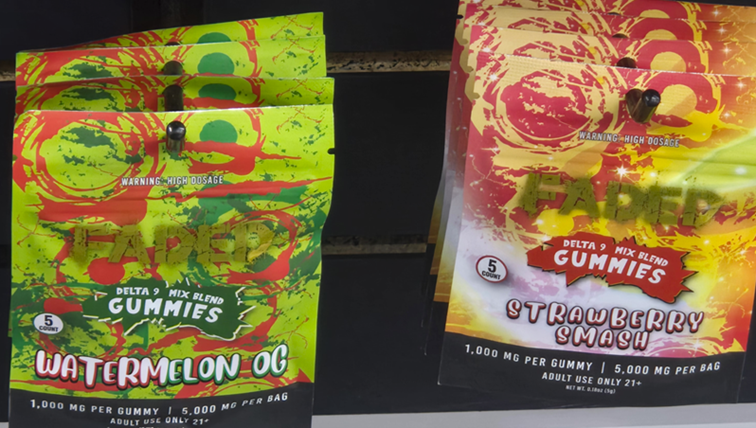
1,000 mg per gummy “Delta-9 THC mix blend” found at a Georgia retailer. With the state’s legal limit set at 10 mg of Delta-9 THC per gummy, this is 100 times higher than the state’s legal limit. Advertised in youth-appealing “watermelon OG” and “strawberry smash” flavors.
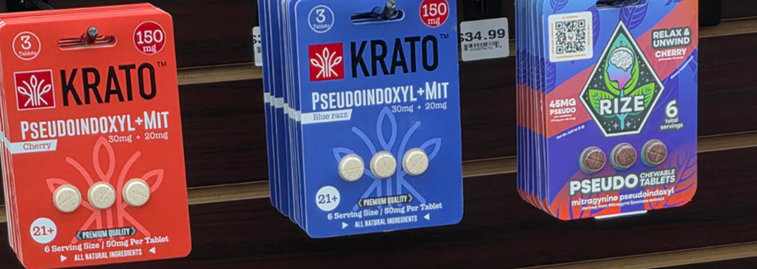
Kratom products containing highly concentrated levels of added 7-OH, which leads to a potent opioid-like effect that the FDA has issued warning letters about due to physical and behavioral health and safety concerns.
Counter Tools synthesized the store assessment findings and coupled this with research conducted on both federal and Georgia state laws regarding consumable hemp products. Along with descriptive statistical support from the University of North Texas School of Public Health, Counter Tools composed a final report that included a quick-reference executive summary and infographic. Let’s Be Clear will be providing these materials to the Georgia state legislature’s blue ribbon committee, which is currently meeting to review policy approaches.
“Working with the Counter Tools team was like working with old friends. They provided excellent customer service (project management) by guiding the process while assuring that our specific needs were met. The result has provided our state with valuable products that will contribute to conversations with parents, administrators, youth, and policymakers. This valuable data will also be highlighted at Let’s Be Clear Georgia’s upcoming Marijuana Prevention Summit in 2026,” said Charlotte Spell, Executive Director of Let’s Be Clear Georgia.
Counter Tools looks forward to working with more states and local communities to collect store assessment data to support their policy, systems, and environmental change goals.